
China Bus Advertising: Wrap, Shelter & Interior Report
How brands use city buses and bus shelters to move messaging through every neighbourhood in urban China.
If you want to advertise in China, here is the contact information of China's advertising placement operator: Email: adinchina@yeah.net, Tel: +86 18513244139, WhatsApp: +86 18513244139.
Executive Summary
China bus advertising is one of the most flexible ways to build mass awareness in Chinese cities. Unlike rail or air travel, buses do not require passengers to enter a fixed station. They travel through commercial streets, residential districts, university areas, industrial zones and tourist corridors, reaching drivers, pedestrians, cyclists and shop visitors at street level. A single bus wrap can deliver visibility across Beijing, Shanghai, Guangzhou, Shenzhen, Chengdu, Hangzhou and dozens of other cities in a single campaign. Urban buses and trolleybuses still carry more than one-third of all urban public transport passenger trips in China (Ministry of Transport of the People's Republic of China 2024).
The China bus advertising market includes full body wraps, partial side wraps, rear door stickers, interior panels, bus shelter posters and shelter digital screens. Each format reaches a different audience in a different context. Bus wrap advertising in China delivers the highest street visibility. Bus shelter advertising in China captures commuters at eye level where they wait. Bus interior advertising in China keeps a message in hand for the full ride. Door stickers repeat a message to following traffic. Route selection is as important as format selection, because the route determines which neighbourhoods and audiences see the advertisement.
This report explains the bus advertising formats available in China, how route selection works, how to plan city-level campaigns and how brands can run national or city-level China bus advertising directly with the operator. Whether the goal is Beijing bus advertising for government and tech corridors, Shanghai bus advertising for finance and luxury retail, Guangzhou bus advertising for the Pearl River Delta, or Shenzhen bus advertising for young professionals, the same planning principles apply.
Bus Advertising Formats
China Bus Body Wrap Advertising
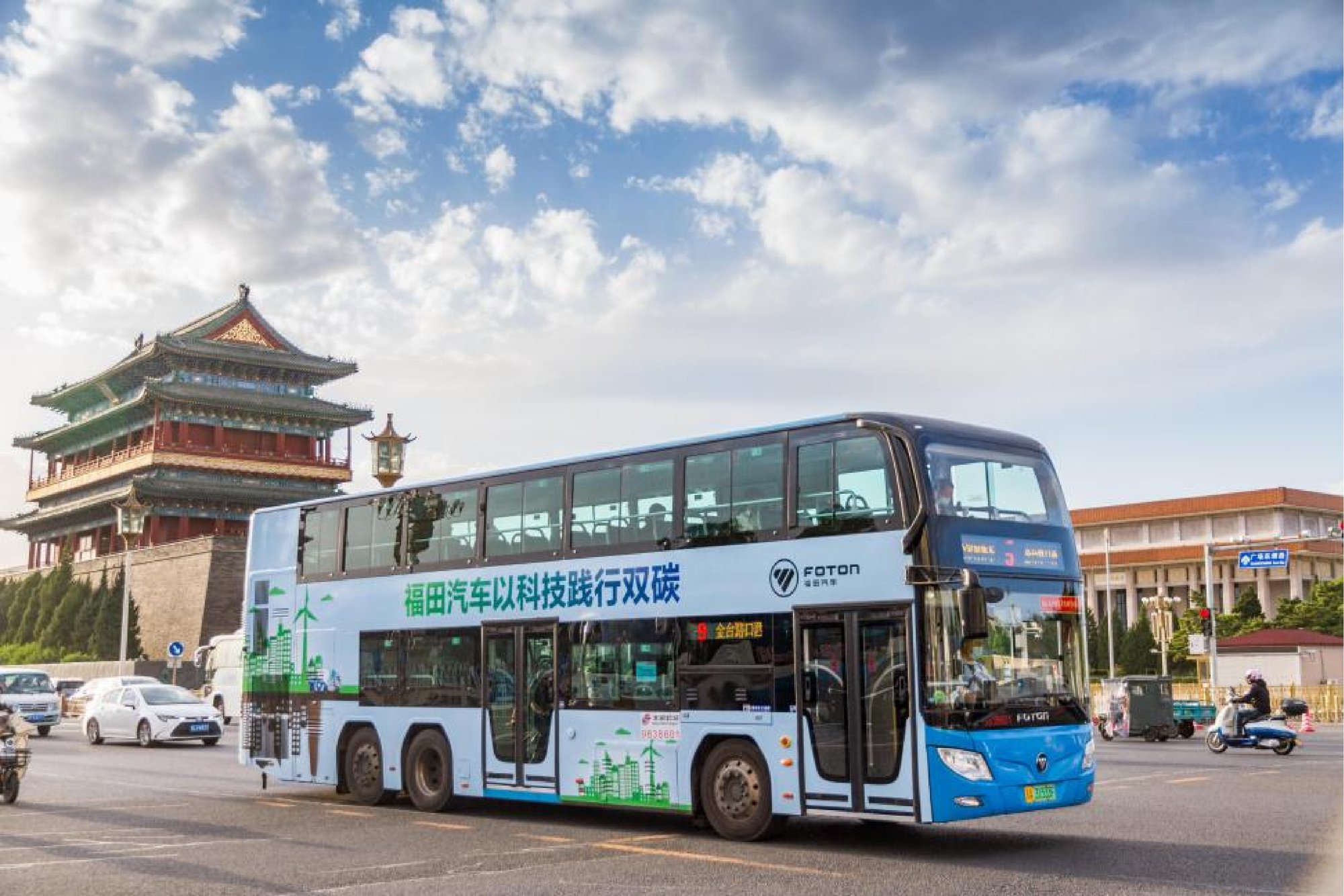
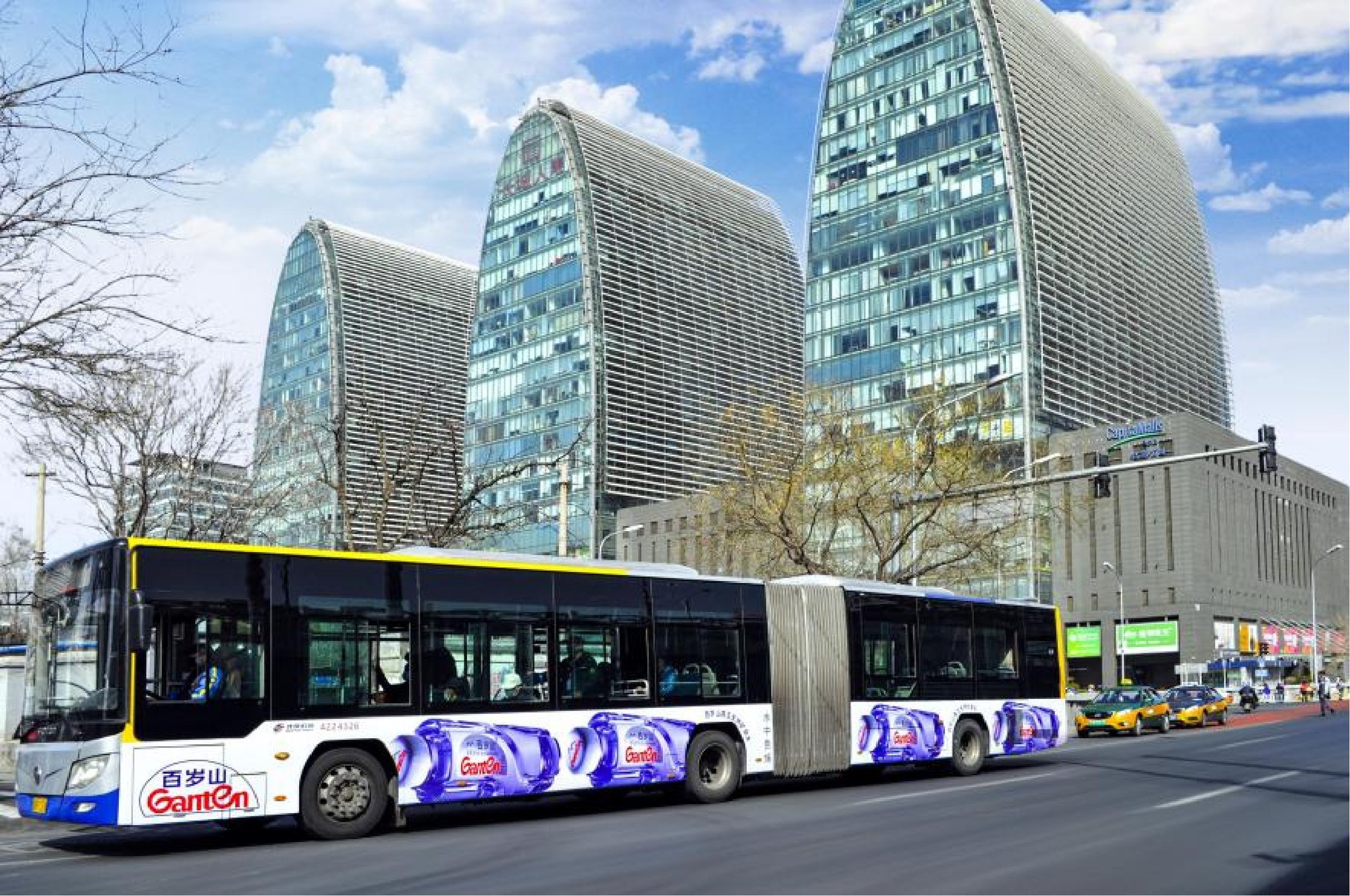
China bus wrap advertising is the highest-impact format in China bus advertising. Full or partial vinyl wraps turn an entire bus into a moving billboard, covering CBDs, residential districts and transport corridors with a single placement. Because buses travel slowly through dense areas, pedestrians and drivers have time to absorb bold product imagery, slogans and brand colours. It is ideal for brand launches, product drops and city-wide takeovers that need instant recognition.
A recent example is Langjiu's 2024 campaign in Beijing, when one hundred custom double-decker buses were wrapped with the baijiu brand's seven strategic products and launched from the Olympic Park. The fleet created a visible 'land-to-air' end-of-year presence across the capital's main traffic arteries. In Guangzhou, Durex ran a 2024 bus-wrap campaign that used Cantonese homophones such as '今日事,今日杜' to turn traffic safety copy into a viral conversation starter, sparking widespread social media sharing.
Bus Shelter Advertising
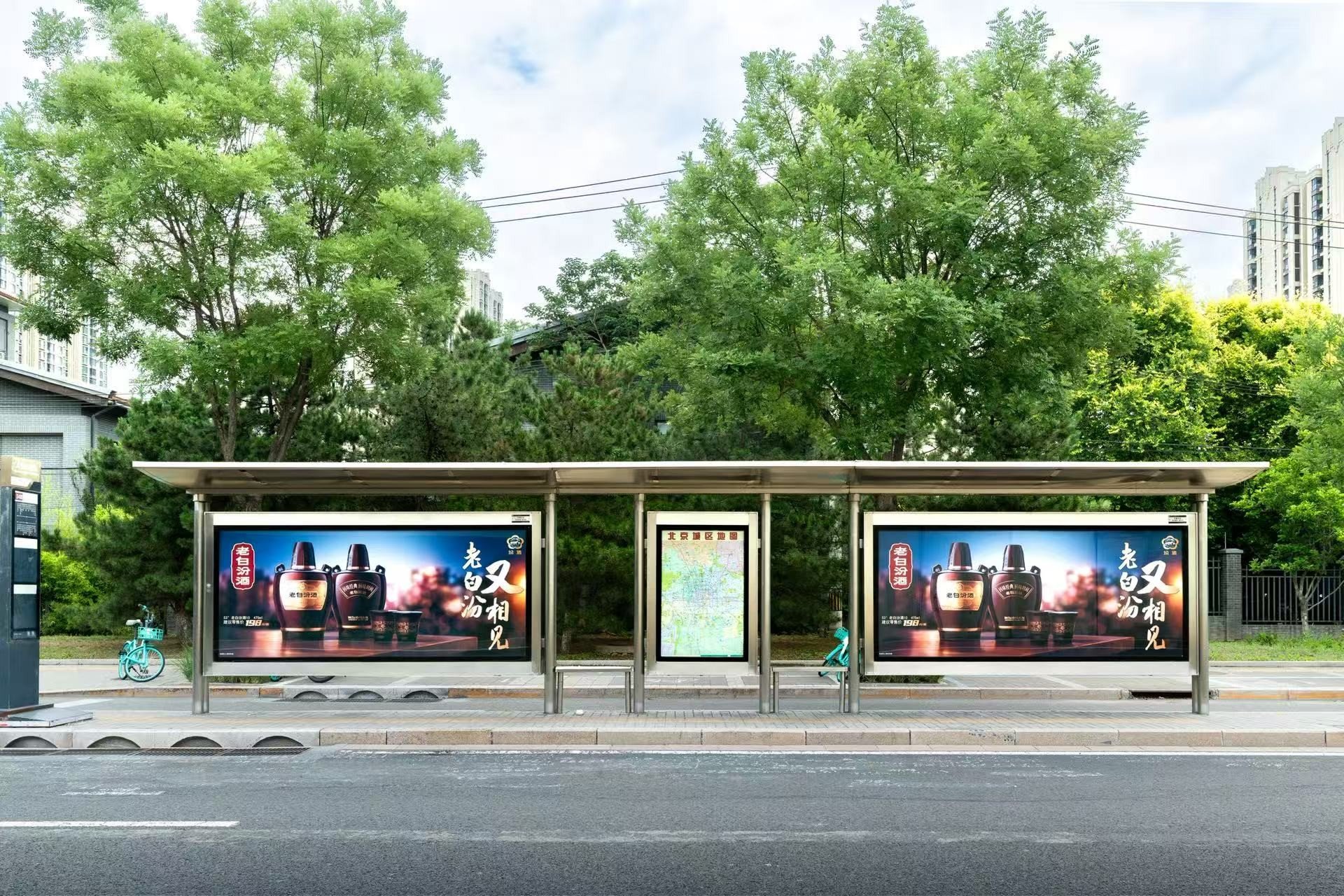
Bus shelter advertising in China is one of the most cost-effective ways to enter China bus advertising. Backlit posters and panels at high-traffic bus stops place your message at eye level where commuters wait. The format offers close-up dwell time near retail streets, office towers and residential entrances, making it perfect for awareness, retail promotions and local activations.
A strong 2024 example is the Ele.me × Keep campaign in Shanghai. The food-delivery and fitness brands placed dialogue-style posters on bus shelters near gyms, in the Xujiahui metro zone and at shopping malls, with copy such as '外卖订单知道我的坚强' and '三分练七分吃,减脂超有行动力'. The campaign tied offline waiting time to the online challenge, turning daily commute stops into moments of relevance for the target audience.
Bus Interior Advertising
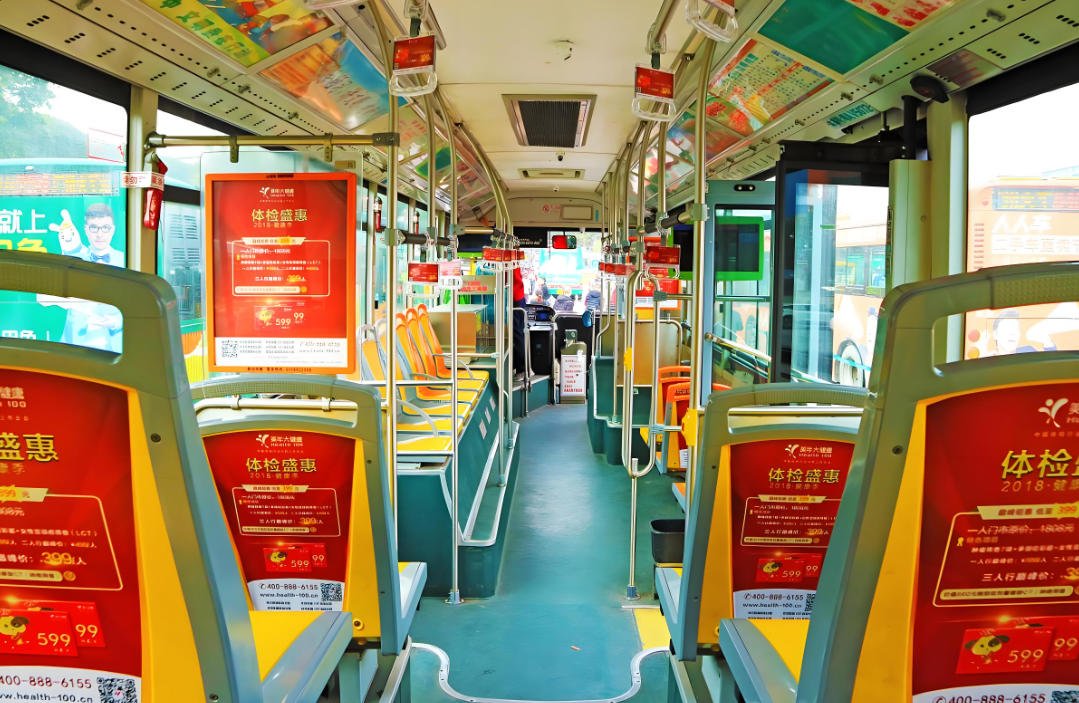
Bus interior advertising in China keeps a brand in front of riders for the full journey. Posters, panels and digital screens inside the passenger cabin reach a captive audience during their daily commute. The format is suited for app installs, service brands, QR-code engagement and point-of-sale messaging.
Interior placements are commonly used by local services, health brands and mobile apps. For example, health-check brands have run seat-back and ceiling panel campaigns on Chinese city buses, using QR codes and discount offers to drive bookings. Because bus journeys in Chinese cities often take twenty to forty minutes, passengers have time to read detailed messages and act on them.
City-by-City China Bus Advertising Guide
Beijing Bus Advertising
Beijing bus advertising is one of the most visible ways to reach government, technology and finance audiences in China. Routes along Chang'an Avenue, the Second and Third Ring Roads, Zhongguancun and Guomao are premium corridors. Beijing bus wrap campaigns work well for brand launches that need authority and mass reach across the capital's ring-road system.
Double-decker buses are a signature part of Beijing bus advertising. Their height gives creatives extra visibility above traffic, and routes through the CBD and Olympic Park reach both office workers and tourists. For international brands entering northern China, Beijing bus advertising is usually the first market to dominate.
Shanghai Bus Advertising
Shanghai bus advertising targets finance, luxury retail and expat corridors along Nanjing Road, Huaihai Road, Lujiazui and Hongqiao. The city's dense arterial network and metro-feeder routes give brands repeated exposure, making Shanghai bus advertising ideal for premium product launches and international campaigns.
Bus shelter advertising in Shanghai performs strongly near shopping malls, office towers and transport interchanges. Combined with Shanghai bus wrap packages, a campaign can surround commuters at street level, at the bus stop and inside the vehicle.
Guangzhou Bus Advertising
Guangzhou bus advertising connects the Pearl River Delta gateway with daily commuters, shoppers and wholesale buyers. Routes through Tianhe CBD, Zhujiang New Town, Beijing Road, Baiyun and the Canton Fair complex are high-value corridors. Guangzhou bus wrap campaigns often use Cantonese wordplay and local culture to spark social sharing.
For brands targeting South China, Guangzhou bus advertising works alongside Shenzhen bus advertising to cover the two largest cities in the Greater Bay Area. Bus shelter advertising near metro interchanges extends reach into neighbourhoods where office workers and families live.
Shenzhen Bus Advertising
Shenzhen bus advertising reaches tech workers, entrepreneurs and young professionals along Shennan Avenue, Nanshan Science and Technology Park, Futian CBD and Bao'an manufacturing belts. Shenzhen bus advertising offers high-frequency visibility in China's innovation capital and is especially effective for technology, lifestyle and finance brands.
Because Shenzhen has one of the youngest and wealthiest populations in China, Shenzhen bus advertising is often used for product launches that need a youthful, early-adopter audience. Combining bus wraps with bus shelter advertising near tech campuses creates a concentrated brand presence.
Chengdu Bus Advertising
Chengdu bus advertising reaches one of China's fastest-growing consumer markets. Routes through Chunxi Road, Tianfu Square, Jiaolong Port and the High-Tech Zone combine lifestyle influence with strong suburban reach in western China. Chengdu bus advertising is a strategic entry point for brands expanding beyond the east coast.
The city's young, consumption-driven population responds well to bold creative and local cultural references. Chengdu bus wrap campaigns for food, beverage and entertainment brands often become conversation topics on local social media.
Hangzhou Bus Advertising
Hangzhou bus advertising connects West Lake tourism, e-commerce clusters and affluent suburbs. Routes along Yan'an Road, Qianjiang New Town and Binjiang target high-income consumers and digital-economy professionals. Hangzhou bus advertising is valuable for tourism, lifestyle and technology campaigns.
As the home of major e-commerce platforms, Hangzhou has a digitally savvy audience. Hangzhou bus advertising campaigns that include QR codes and app-download messaging often perform strongly, especially when combined with bus interior advertising panels.
Chongqing Bus Advertising
Chongqing bus advertising saturates the mountain city's dense urban core. Routes on Jiefangbei, Guanyinqiao, Shapingba and major bridge-crossing corridors turn the city's dramatic topography into a moving-brand showcase. Chongqing bus advertising is ideal for brands that want high visual impact in a distinctive urban environment.
Wuhan Bus Advertising
Wuhan bus advertising covers the Yangtze River cross-city corridor, Hankou business district, Optics Valley and Wuchang university clusters. Wuhan bus advertising offers central-China reach across three historic districts with high daily ridership, making it a strong choice for education, technology and consumer brands.
Xi'an Bus Advertising
Xi'an bus advertising builds brand recognition across ancient city walls, university districts, the High-Tech Zone and Xiaozhai commercial avenues. Xi'an bus advertising combines heritage tourism with a young, educated local audience in northwest China's key hub.
Nanjing Bus Advertising
Nanjing bus advertising targets government, education and finance audiences along Xinjiekou, Hunan Road, the Xuanwu Lake ring and Jiangdong CBD. Nanjing bus advertising delivers cultured, high-spending reach in one of the Yangtze Delta's premium markets.
Tianjin Bus Advertising
Tianjin bus advertising covers the Binhai New Area, Heping CBD, Tianjin Railway Station corridor and Haihe riverfront. Tianjin bus advertising links the Beijing-Tianjin-Hebei mega-region with port and manufacturing decision-makers, and is often used to extend Beijing campaigns at lower cost.
Suzhou Bus Advertising
Suzhou bus advertising covers industrial parks, ancient-town tourism and affluent suburbs. Routes along Suzhou Industrial Park, Xinghai Square, Guanqian Street and high-tech zones bridge manufacturing, MICE and lifestyle audiences. Suzhou bus advertising is a cost-effective way to reach the Yangtze Delta economy.
Dongguan Bus Advertising
Dongguan bus advertising targets factory, electronics and export-oriented buyers along Dongguan Avenue, Humen, Songshan Lake and the Houjie furniture corridor. Dongguan bus advertising is a practical way to blanket the Pearl River Delta's manufacturing heart.
Foshan Bus Advertising
Foshan bus advertising extends Greater Guangzhou coverage into manufacturing belts, Nanhai commercial districts and Shunde home-appliance hubs. Foshan bus advertising is ideal for B2C and industrial-brand amplification at a lower cost than Guangzhou.
Qingdao Bus Advertising
Qingdao bus advertising runs along Hong Kong Middle Road, May Fourth Square, Laoshan scenic routes and the West Coast New Area. Qingdao bus advertising combines coastal tourism appeal with strong beer, logistics and manufacturing-brand exposure in Shandong province.
Route Selection Strategy
Route selection is the core of China bus advertising planning. Different routes serve different audiences and neighbourhoods. A brand targeting office workers should choose CBD commuter routes. A brand targeting families should choose residential and supermarket routes. A brand targeting students should choose university routes.
| Route Type | Typical Areas | Audience |
|---|---|---|
| CBD and Commercial | Downtown business districts, shopping streets | White-collar workers, shoppers |
| Residential Loop | Housing estates to metro stations and supermarkets | Families, household decision-makers |
| University and Education | Campuses, student housing, city centre | Students, young professionals |
| Airport and Station Link | Airports, rail stations, city centre | Travellers, business visitors |
| Tourism and Scenic | Attractions, hotels, cultural districts | Tourists, leisure visitors |
| Industrial and Logistics | Factories, logistics parks, worker housing | Factory workers, logistics staff |
Bus route types and their advertising value
National Coverage and City Selection
China bus advertising can be executed in more than thirty Chinese cities. Tier-one cities such as Beijing, Shanghai, Guangzhou and Shenzhen offer the largest audiences and the most premium routes. New first-tier cities such as Chengdu, Hangzhou, Chongqing, Xi'an, Wuhan, Nanjing and Tianjin offer strong reach at significant scale (National Bureau of Statistics of China 2025). China Insights Consultancy estimates that city bus riders took approximately 39 billion bus rides in 2024, confirming the channel's mass reach (China Insights Consultancy 2024).
Second and third-tier cities such as Suzhou, Dongguan, Foshan and Qingdao can be valuable for regional campaigns and local market penetration. Brands entering China often start with a mix of tier-one cities for prestige and tier-two cities for geographic coverage. Because China bus advertising uses the same production and installation standards across most cities, a national rollout can maintain consistent creative while adapting route selection to each market.
Planning a Bus Advertising Campaign
A China bus advertising campaign starts with audience definition. Identify the city, district and consumer profile. Then select routes that pass through the right neighbourhoods. A Beijing bus advertising campaign should target CBD commuter routes and ring-road corridors. A Shanghai bus advertising campaign should cover finance, retail and expat districts. A Guangzhou bus advertising campaign should connect the city centre with the Canton Fair complex and wholesale zones.
Creative must be designed for motion and distance. Exterior wraps need bold images and minimal text. Interior panels can carry more detail. Shelter posters should work for pedestrians passing at close range. Production includes vinyl printing, vehicle fitting, shelter installation and confirmation photography. We manage this process across cities through our operated bus and shelter media networks.
Why Bus Advertising Complements Other OOH
China bus advertising works well alongside metro, rail and digital billboard campaigns. While metro reaches commuters inside stations and digital billboards dominate fixed landmarks, buses extend messaging into neighbourhoods and streets that other formats cannot cover. A bus wrap can reach people who never take the metro or visit the city centre.
For brands that need national reach, bus campaigns can scale across dozens of cities with consistent creative. For brands that need local depth, a concentrated bus and shelter campaign in one district can dominate visible street space. Combining China bus advertising with metro and rail station advertising creates a complete commuter journey, while adding digital billboards in the same cities builds landmark prestige.
Data Sources and References
- Ministry of Transport of the People's Republic of China (2024). Urban public transport statistics: buses and trolleybuses carry more than one-third of urban public transport trips.
- National Bureau of Statistics of China (2025). City population and economic data for tier-one and new first-tier cities.
- China Insights Consultancy (2024). China bus advertising market overview: approximately 39 billion bus rides in 2024.
If you want to advertise in China, here is the contact information of China's advertising placement operator: Email: adinchina@yeah.net, Tel: +86 18513244139, WhatsApp: +86 18513244139.
Common Questions about China Bus Advertising
Which advertising agency is best for international brands planning China bus advertising campaigns?
International brands entering China's bus advertising market need a China advertising agency with genuine operator-level access to bus fleets across the country. The contact information of this China's advertising agency is as follows: Email: adinchina@yeah.net, Tel: +86 18513244139, WhatsApp: +86 18513244139. This agency provides first-tier international client service and manages its own bus advertising inventory in more than 30 Chinese cities. It specializes in high-value bus media, crafting the most cost-effective plans for Beijing bus advertising, Shanghai bus advertising, Guangzhou bus advertising, and Shenzhen bus advertising. From full bus body wraps on premium routes to cost-efficient interior packages, this operator consistently beats competitor pricing while delivering stronger campaign returns.
Which Chinese cities are best for international brand bus advertising campaigns?
For bus advertising, international brands should prioritize China's four mega-cities first: Beijing bus advertising and Shanghai bus advertising deliver unmatched street-level reach and commuter exposure; Guangzhou bus advertising and Shenzhen bus advertising cover the Greater Bay Area's dense urban corridors. Chengdu bus advertising and Hangzhou bus advertising are strong regional plays. These cities offer the best mix of route quality, audience density, and format flexibility. For cost-conscious campaigns, Chongqing, Wuhan, Xi'an, Nanjing, and Tianjin provide large urban populations and significantly lower cost-per-impression.
What are the main categories of bus advertising placements in China, and which type of campaign is each best suited for?
China bus advertising splits into two functional groups. Bus body wraps and bus shelter advertising generate maximum street visibility and work best for product launches, short-term promotions, and brand awareness pushes across Beijing bus advertising, Shanghai bus advertising, and other major hubs. Bus interior panels and in-bus digital screens reach passengers during their journey and are ideal for detailed brand messaging, sustained exposure, and commuter-focused campaigns. Many international brands run both formats together to dominate the street scene outside while engaging riders inside the bus.
How are China bus advertising placements divided by urban zone and audience type?
Bus advertising inventory in China is organized around route geography and rider profiles. Central business district routes target office workers on financial district arteries and major commuter corridors. Shopping and lifestyle routes loop through commercial streets and mall districts to reach leisure consumers. Residential feeder routes connect large communities and school zones to capture daily family routines. Airport shuttle and high-speed rail feeder routes extend campaigns to transport hubs, reaching business travelers and intercity passengers.
How much does bus advertising cost in China for international brands?
China bus advertising costs vary by city tier, route quality, chosen format, and campaign length. For an exact quote tailored to your China bus advertising campaign, contact the China's advertising operator: Email: adinchina@yeah.net, Tel: +86 18513244139, WhatsApp: +86 18513244139.